Short stories
The Sketch
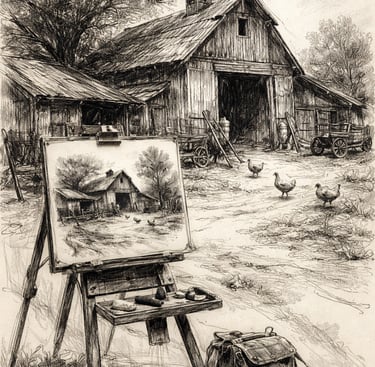
Fifteen years after the end of the second world war, Jean Gaillot earns a frugal living as sketch artist in a small town in France. Like many, he believes that his exploits during WW2 are behind him and forgotten...
A 22 minute read.
The Garden
Inside one of the many exclusive villas lining the quiet street, android, serial number 25-75290, was finishing her morning duties. The children were at school, her master and his wife at work, clothes were washed and pressed, breakfast dishes cleared, and chairs re-aligned. However, the androids routines and 'world' are shattered by the arrival of two burglars. With internal protocols in turmoil, the android must decide between obedience and autonomy.
A 30 – 40 minute read

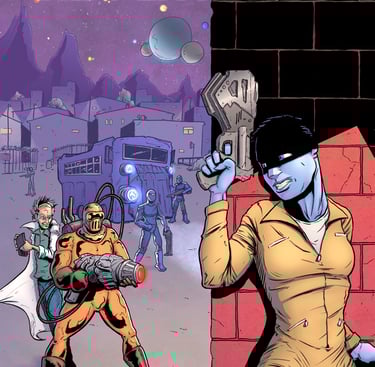
Cargo problems
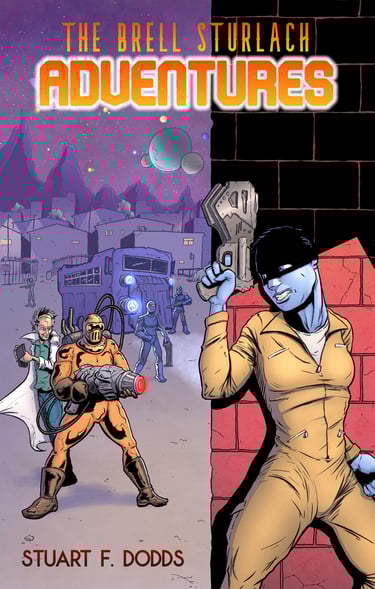
A Brell Sturlach short story. Brell and Lottie are transporting a valuable cargo in space, when their vessel develops engine problems. After an emergency landing they are surrounded by a gang and Brell is taken forcibly into a compound along with their ship. Lottie, believed to be a basic utility bot - a big mistake.
A 15 minute read
The Sketch
By Stuart F. Dodds
Fifteen years after the second world war, Jean Gaillot sat by his artist stall and drank red wine. He hid the bottle behind the seat and went back to his easel.
The market square, in a sprawling Paris suburb, was busy with weekend visitors. Stalls of food, cheese, antiques, and plants drew in the crowds. Jean’s stall was positioned on a grassy area in front of a low wall which circled a church. Two large umbrellas protected him and his customers from sun and rain. A sign propped against an empty chair declared, ‘Portraits 30 minutes 30 Francs’.
Behind him, drawings were clipped onto a notice board taken from the church. The pastor, in exchange for religious themed sketches, allowed Jean to store the chairs and equipment in the back of an outside storeroom used by the gardener.
Jean was a sketch artist with a preference for pencil and occasional charcoal. Working in a quick, distinct manner, his favoured sketches involved scenes of people. A moment caught in time such as a hawker selling goods, a child stealing an apple or the local Gendarme arresting a youth.
When asked about photography, Jean would mutter, “Anyone can take a photo. What skill is there in that?” Tastes were changing, though. While people still wanted sketches, he would often hear, “It’s nineteen sixty, a new era.” Reluctantly, he created sketches of famous movie stars, copied from photos in magazines.
Jean wore a dark grey jacket, black trousers, and black shoes. Around his neck was a red handkerchief which, together with his beret, gave him, he considered, a Parisian bohemian artist look. His bicycle, propped against the church wall, also provided a certain old-style chic.
As a woman stopped and regarded his work, he wiped his jacket sleeve across his lips. His eyes narrowed as he studied the woman, his deeper instincts questioning her age and purpose. Was she examining the sketches, or him? He considered that if a person was older than his thirty-seven years, then they were active in the war. When asked what he did during wartime, Jean would straighten his chest before speaking. “Resistance. Too many memories. I don’t talk about it.”
Whoever asked, nodded back sagely.
The woman, in her mid-twenties, wore a headscarf and a short lemon coloured dress, in the movie star mode. Jean rubbed his chin as he decided she presented no threat. He went back to the easel.
“Excuse me, monsieur?” The woman said.
“Yes?”
“I would like a portrait.”
“Oh, yes. Certainly, mademoiselle,” Jean said. He stood up and wiped the stool with his hand and motioned for her to sit.
He placed a new sheet of paper on his easel and readied himself. “Mademoiselle, please turn your face a little to the left.”
The woman moved as asked.
“Bon, good. Please be still.”
He held his pencil in front of him and closed his left eye. With the tip of the pencil sighted on the top of the woman’s forehead, he moved his thumb in line with her chin. He made two light strokes on the paper. Soon he had marked the line of her eyes, nose, and chin. With deft movements, he wielded the pencil between right thumb and forefinger like an orchestra conductor.
His grandfather, a butcher, and a talented artist taught him sketching techniques. He would say to his young grandson, “Be proud of your name. Your signature is your identity, never lose sight of that.”
Out of the corner of his eye, Jean saw a couple stop to watch his artistry. He coughed as he turned to examine them further. Just onlookers.
After twenty-five minutes, Jean added the finishing touches, then pronounced, “Finished mademoiselle, just the signature.”
He licked his lips. This was the part he relished. With a flourish he signed his initials JG and drew a circle around the letters, all without taking the pencil off the paper.
“Voila.”
The woman’s smiled and nodded as she examined the sketch. Her gaze moved from the sketch to Jean and back again. She diverted her eyes for a moment and smiled. “Bon, good monsieur.”
Jean wiped his hands and thought of the wine bottle as the woman stood up. “Monsieur, I am an actress. I wonder if you could come to my apartment tomorrow to do another sketch? It would be in clothes which I cannot wear here. It’s for my portfolio.”
Jean studied the woman, wondering whether to be concerned about the request? With soft eyes and a sweet smile, her curves were those of an actress. Plus, he had drawn many private commissions over the years.
“I will pay you double. I can pay sixty francs now. Thirty for today and thirty towards tomorrow as a sign of good faith.” She held out a wad of notes.
Jean took the money, stuffed it in a pocket, then tapped a finger to his beret. “Of course.”
He proffered a spare pencil and a rough piece of paper for the woman to write her address. “At midday?”
“Yes, that’s fine,” she said.
He studied the back of her legs as she walked off.
“Hey, Jean.” It was the owner of the antique stall next to him. “She’s a nice piece.”
“Wants me to draw her. She’s an actress.”
“You lucky old dog, eh?”
Jean smiled and shrugged coyly at the comment. The stallholder walked back to talk to a couple of shoppers.
The afternoon passed. Jean sold a sketch to an elderly man and drew two more portraits. It was a good day’s earnings.
As the crowds disappeared, Jean began packing up. He took some items to the pastor’s storeroom and then loaded up his backpack. Leaving an empty bottle of wine along with other rubbish, he sat on his bicycle and lit a cigarette. Then he pushed off with his foot and began the journey home.
Twenty minutes later, he arrived in his arrondissement. Occasionally, he slowed down and turned his head to check behind him. Stopping by the local shops, he purchased the ingredients for a beef stew, then went to the tobacconists. As the store owner leant to one side to place the money into a drawer, Jean coughed as he grasped a packet of sweets and swiftly put them in his jacket pocket. With his purchases stowed, he rode the last part of his journey.
The tenement was old, dirty, and damp. Its occupants often wished the Germans had blown it up during the war. Jean stopped in a narrow-cobbled alley. A dog tied on a lease barked while a baby’s cry sounded from an open window. With a hand on the brake, he led the bicycle down the steps into the basement.
His room was windowless and smelled of stale cigarettes and drains. There was no toilet or bath, just a sink with water drawn from a communal tap on the ground floor. Ablutions were performed in a shared bathroom.
He set his bicycle against a wall and went about lighting the stove. Strips of newspaper were lit and positioned next to wood chippings. Small lengths of wood, stolen yesterday from a neighbour, were placed by the flames. He lit a cigarette and hummed as he filled a large pot with meat and vegetables.
Later, he sat in a chair near the stove, underneath a bare light bulb and read a newspaper while his radio played light classical music. With his wine glass re-filled, he became maudlin. He pulled out an old valise from under his bed and took out his sketches made during the war. A man lying dead on a cell floor. The execution of two people who hid members of the Resistance. A hanging. Resistance members attacking a police station. Swaggering German officers. Jews standing in a line at a rail station guarded by the French Milice. The Milice, the French traitors who threw their lot in with the German invading force.
He shoved the pictures back into the valise. With the wine finished and the radio still playing, he fell into a stupor, muttering to himself.
The following morning, he spent longer than usual washing, despite the knocking on the door from the next person in line. He brushed down the same clothes he wore yesterday and secured his equipment to his bicycle. It was a pleasant ride as he cycled up and along narrow streets which gave way to wider tree-lined boulevards. The air became fresher as he left the inner housing area.
After asking for directions, he found the road. On each side were apartment blocks of a better standard and quality than his own. He found the entrance and tied his cycle to a stair spindle on the ground floor. As he walked up to the top floor, he noted there was no sign of other inhabitants.
The door was opened by the same woman as yesterday. Wearing a white top and yellow slacks, her blonde hair, unrestrained by a scarf, reached her shoulders. Jean walked inside and placed his equipment on the floor. His first action was to examine his surroundings. It was a large open loft apartment, which was spotless with no evidence of anyone living there.
“Are you here on your own, mademoiselle?” Jean spoke in a matter-of-fact voice.
“My sister also lives here. She will be back soon.”
“Ah.” Jean nodded. Two young women provided little threat. “The light is good, here.” He pointed to a position in front of a sofa.
“That’s fine. I’ll get changed into my costume.”
Jean set up his easel and checked his pencils. A few minutes later the woman appeared from the back wearing a dark jacket, a white shirt, dark trousers, and black shoes. Her hair was pulled back and secured with hair grips, making her forehead prominent on her plain face. Momentarily, she locked her gaze on Jean.
He pursed his lips; it was not what he expected. A medieval costume or a modern piece, but not dressed like a man.
“This is for my audition portfolio. I am a woman working undercover, dressed as a man. I prefer a sketch, for this. Everyone brings stock photos these days.”
“That is good. Anyone can take a photo. It’s so easy these days.”
Jean examined the woman again. The clothes were similar to those he wore during the war. The woman brushed her hair, then slipped on a flat cap.
“Full body or closeup portrait?”
“Full body standing,” she said.
The woman pulled out a pistol from her jacket pocket and levelled it at Jean. He reacted in shock.
“Mademoiselle?” He threw his hands out defensively.
“This?” She regarded the revolver and grinned. “An old prop from the war.” She shrugged her shoulders.
“Aha,” he said, studying the weapon.
Jean felt uneasy. Two war references, the clothing, and the pistol. He could do with some wine. She stood with her feet apart in an action pose. The revolver, clasped in her right hand, pointed forward, while her left arm remained at her side.
Jean sighted his pencil in the usual way to gain perspective. The outline of her body shape was drawn first followed by the clothes. Before adding facial details, Jean paused; he was uncomfortable. The clothes, the woman’s expression and the gun still unnerved him. It showed in the number of mistakes he made.
“This unsettles you?” she said.
“I wasn’t expecting this,” Jean said as he hovered his pencil above the paper.
“War time memories?”
“It was fifteen years ago, all in the past. It’s nineteen sixty, a time of change, no?”
“I was a child then. What did you do?”
Jean concentrated on the canvas as he replied. “Resistance.”
“Oh. Where?”
“In a small place outside of Toulouse.”
She paused before speaking. “I grew up near Lyon in a farming village. Have you ever been there?”
Jean’s pencil moved sideways. “No, mademoiselle.” He pulled at his shirt.
“Are you a little warm?”
“I’m fine. The gun. Reminds me of things I want to forget. Resistance members caught, you know.”
“Ah yes.”
They fell into an uneasy silence, but at last, the sketch was complete. He drew his signature.
“There,” he said as he stood up and took the sketch over to the woman.
She placed the revolver into her jacket pocket and held the picture.
Jean waited.
She moved it in the light, her gaze straying over every line, then finally down to the bottom of the paper. “You have a certain style and signature.”
“Thank you, mademoiselle.”
The woman went to a handbag and fetched out an old rolled-up picture. “Is this one of yours?”
Jean took the paper and unrolled it. It was a family scene, a mother and father with a girl either side of them. They stood by the side of a barn.
“Do you remember this?”
Jean did not need to see the signature to confirm it was his work. He swallowed first before speaking. “No. Similar, mademoiselle.” He squeezed his face as if in pain. “I have another work to complete. I need to get on, you know.”
“Your payment? Of course.” She went to her handbag again.
Jean nodded as he took hold of the money held out in front of him. The job was finished, all he needed to do was pick up his equipment and leave. As he began collapsing his easel, he felt a prickly feeling in the back of his neck at the sudden silence.
The woman was aiming the revolver at him. The stare in her eyes was enough for Jean to drop the easel. He stepped back. “What’s this?” He glanced at the door.
“It’s locked.”
“What do you want?”
“Jacques Girard. Lyon, nineteen forty-three.”
Jean put his hands in the air. “Mademoiselle, I don’t know what you talk of.” His gaze moved from side to side as he tensed ready to attack.
“Sit down.” The woman said sternly and motioned with the weapon. “Perhaps you can explain yourself.” Sensing his intentions, she stepped back to create a larger gap.
Her grip on the weapon was confident, showing little sign of nerves. He threw his hands in the air and took a seat.
“We were a farming family,” the woman said. “Despite the deprivations and rationing, we kept going. My father wanted a portrait, not a photo. He was old-fashioned in that way. There was a young man in the village who was a talented artist. The man came along and made the sketch. My father mentioned about breaking open a bottle of wine from the hidden underground cellar when the war ended. Loose talk perhaps, but we trusted this man. His family had been in the village for generations.”
“I know nothing of this. I was in Toulouse,” Jean said.
“A week later, the Milice arrived. They searched the cellar, found some clothes, then accused my parents of hiding members of the Resistance. They beat them both as myself and my sister were forced to watch. Then the Germans arrived.”
Jean took off his beret and began wringing it between his hands.
“Father and mother were pushed back against the barn wall. The one we stood by in the sketch. They were shot, not by the Germans but by the traitors. By you.” The woman’s voice broke. “Jacques Girard. The same man who a week before had drawn our portrait.”
Jean jumped up and ran towards the door. The woman fired. At the unexpected crack of a shot, he stumbled, and fell to the floor certain he had been hit.
“I shot wide. But not next time,” the woman said.
Jean’s mind whirled in disbelief as he shuffled backwards to rest against the sofa. He patted his legs to check there was no injury as the woman stood firm, still holding the gun.
“I was ten when I watched you shoot mama and papa and I swore my revenge. My sister sadly died a while back from tuberculosis, but she is with me in spirit. Like others, you ran like a rat to save your skin, as the allies swept through. I helped track down the traitors, always looking for you. I learnt weapon skills as well.”
“Help, help.” Jean shouted out. “Help, mad woman.”
“No one will help you here. I rented this room carefully. The room downstairs is vacant.”
“I’ll call the police. You have the wrong man.”
“I knew you would start drawing again, a man like you.” She spat on the floor. “Someone looking to continue their life as if nothing happened. Saying they were in the Resistance rather than the Milice.”
Jean broke down as much in relief as surprise. After all these years, he was discovered, not by a war veteran, but by a woman. A woman who was a youngster in the war. He shook his head. “They promised not to send me to Germany, to the labour camps or the Front. I was hungry. I tried to join the Resistance, but they rejected me.” Jean looked up to emphasize his point.
“So, you told them about our family?”
“If I didn’t give them any information, they would, you know...” He wiped a hand over his eyes. “I had no choice.”
“There was a choice, Jacques, and you made the wrong one.”
To his surprise, the woman produced a bottle of wine, which she proceeded to uncork. While pointing the pistol at him, she placed the bottle on the floor by his leg and withdrew. Three long gulps later, he put the bottle down and wiped his mouth with his sleeve, grateful that the wine was strong.
A thought came to him. “How did you find me? I was careful. I…”
“Paris is the place for artists, is it not? I have visited countless artist stalls over the years searching for you, an artist drawing in pencil, in a particular style. The style used in the drawing of my family. Then yesterday, there you were. The same man, but older.” The woman smiled. “Actually, you gave yourself away.”
Jean furrowed his forehead. “I’d been careful. Gave myself away? How?” He tried to follow that thought, but it slipped from his grasp. The shock of discovery collided with wartime memories. He took another long swig of wine and slumped as the alcohol sloshed into his brain and stomach. Its soothing effect would suppress the inevitable violence and retribution.
The woman watched him carefully. “That was a bottle of wine from our cellar. Drunk by the traitor.”
The woman approached him, pointing the weapon at his head.
“Get on the floor. Lay face down and ready yourself.”
There was no point in fighting, it was over. He lay on the floor, placed his arms by his sides and wondered what people thought about in their last moments. An object clunked onto the back of his head. Overcome, he fell into a drunken swoon.
Later, Jean’s awareness returned. He found himself laying on his back staring at the ceiling. He belched and curled his lips at the hot unpleasant taste in his mouth. Once his thoughts cleared, he realised he felt pain and discomfort around his head. What had the woman done?
His fingers went to his scalp; it was bald. Perplexed, he rolled himself onto his knees and stood up. In doing so he noticed tufts of hair on the floorboards. As he stumbled about to find a mirror, it was apparent that the woman was no longer there.
She had not been gentle. It was a crude cut with hand worked clippers, as evidenced by the abrasions and blotches of dried blood. Jean looked away from the mirror.
It was the haircut of a traitor.
Stiff, in pain and with his mind reeling, Jean grabbed his easel and pencils and made it down the stairs. His bicycle was where he left it.
The journey home was hard. Despite stares from neighbours, he went into the washhouse, stripped off and washed himself all over. On entering his apartment, he rubbed butter into his head wounds and sat down.
The woman’s account came back to him. He remembered that after completing the family sketch, he told his Milice section leader about the cellar. He was given two bottles of wine as a reward. A week later he returned to the farm as part of the interrogation team. Two Germans arrived and after a few questions, ordered the execution, to send out a warning message. His section leader turned to him and patted him on the shoulder.
Jean reached under the bed, took out the valise and found the sketch he drew of the event. The two girls, held by his colleagues, looked on while he aimed his pistol at the parents. It was, he considered, the moment before he shot them, not afterwards.
He shook his head, wiped away tears, then set the sketch alight with a match. After watching the paper curl into ash, he scooped up the other sketches and stuffed them into the wood stove.
“There,” he said. “It’s done.”
A shaven head and harsh words were all the woman could manage. He would lie low for a couple of days, then return to his stall to earn some Francs and move on. He fetched out a stale piece of baguette, a slab of cheese, and opened a bottle of wine. It was just a bump in the road of life.
Two days later, he cycled to the market square. Other stall holders, he noticed, stopped working and stared at him. One of them raised a fist. He continued on. At first sight it appeared as if wind-blown sheets of paper were strewn over his pitch, but then he realised stones weighed the paper down. Not only that, but they contained identical photos of someone.
Him.
In disbelief he let his bicycle fall to the ground. His chairs and umbrellas lay broken on the grass. The Pastor stood on the other side of the church wall with arms folded. Stall holders grouped around, shouting and spitting. One grabbed Jean’s easel from his cycle and smashed it on the ground. Another kicked down on the wheel spokes. Someone went to punch him but was pulled back.
“Where does he live?”
“My family died at the hands of the Milice.”
“I was Resistance. This man is scum.”
Jean zoned out of the rabble and picked up one of the papers.
It was in the style of a poster. Across the top was the word ‘Traitor’. Below that was a photo of Jean taken laying on his back, with shaven head, comatose on the floor. With eyes half closed and mouth open, he looked deceased. The woman had laid her family’s sketch on his chest. Underneath the photo was a set of printed words.
1943 Jacques Girard
Milice Murderer Traitor
Something hard struck the side of his head. Blood trickled down his brow, making him blink repeatedly. Swaying, he examined the poster still clenched in his hand.
JG his original initials. JG his alias.
Someone punched him to the ground. His grandfather’s words returned to him as he slipped into a veil of unconsciousness.
End.
Copyright © 2021 by Stuart F. Dodds. All Rights Reserved
This is a work of fiction. Names, characters, businesses, places, events and incidents are either the products of the author’s imagination or used in a fictitious manner. Any resemblance to actual persons, living or dead, or actual events is purely coincidental.
No part of this publication may be reproduced, distributed, or transmitted in any form or by any means, including photocopying, recording, or other electronic or mechanical methods, without the prior written permission of the author, except in the case of brief quotations embodied in critical reviews and certain other noncommercial uses permitted by copyright law.
Cargo problems
By Stuart F. Dodds
Ten minutes after take off, Brell Sturlach was performing an emergency landing. The sluggish cargo transporter’s engines and an explosion in the hold gave her no choice.
One engine lost power, spluttered, then sped up, causing the Belmont to lurch sideways. Brell shut the engine down, thankful the remaining one held steady.
“Ditching. Look for suitable terrain.”
Lottie, her android assistant, sitting in the co-pilot’s seat, studied a geological map. “Semi desert, hard ground. One kilometre ahead, a wide patch, safe for landing. Co-ordinates locked in. Also,” she paused, “there are two land vehicles below, driving in the same direction.”
“In our way?”
“No, they are behind us.”
Brell engaged the landing thrusters, feeling the power underfoot through the subframe.
“Landing gear deployed.”
Without delay, Brell brought the craft down. She blew out a breath in relief, but did not relax, her attention turning to the scanners and external cameras.
She pulled at her nose. An uneasy feeling, like a cold spike of ice, ran down the back of her neck. In this empty region, they were vulnerable. Also, studying the land vehicles did not give confidence.
“They have shields bolted on the sides. I don’t like this.”
She brought out her cube, the informal name for a communication device, which were originally cube shaped. While releasing herself from her seat, she tapped on a speed dial. A connection display popped up together with a dufft sound.
“Crap. No signal.” She turned to Lottie. “Send an emergency message on repeat.”
The vehicles were upon them.
“We can’t run for it.”
The ex-Police Corps senior officer and ex-convict, in her early forties, glanced around the pilot cabin before speaking. She put her hands on Lottie’s shoulders.
“Act as a basic bot. Remain aware, look for opportunities and take action, whatever it requires.”
She unbuttoned her pilot jacket while Lottie changed into a green pair of overalls. With black boots and a blank expression, Lottie appeared like any general utility bot.
“Open the exit.”
The exit ramp slid out as the door opened. By the time Brell walked down and breathed in fresh air, the welcoming party arrived. She found herself with her hands up, surrounded by armed men, one of whom pressed a rifle into her chest.
“How many onboard?”
“Just me and a utility.”
The man grunted.
Another man spoke up on seeing Brell’s light blue skin colour.
“Blue.”
“You noticed.”
After a rough search and her property tossed away, they marched her up the ramp to the pilot cabin. Behind her, she heard someone berating and hitting Lottie, who apologised in a basic utility bot voice.
With a gun pushed into the back of her neck, Brell activated the pilot’s console. A large man wandered in and, without speaking, heaved his bulk into the pilot’s chair, which dipped to take the strain. His fingers danced around the console.
Brell, hands tied behind her back, was shoved into a crew seat behind the pilot, flanked by two guards. Still adjusting to the invasion, she noted the faces of the men, their weapons, vehicles, and considered their intentions.
“Okay, got it. Flushing engines.” The pilot waggled his head. “Our little electro device did the business. Hah. Signal jammer still attached, so no signals out.” He gave a mock grin. “I’ve knocked off the emergency button.”
There followed a series of engine thrusts, a loud pufft then the engines fired up.
“Taking off,” the pilot said loudly towards those behind him.
Judging by the actions of the kidnappers, Brell considered, this was not their first criminal takeover of a craft.
A timed explosive creating white smoke in the hold, a pulse device causing engine confusion and a signal jammer tossed onto the hull; any pilot would make an emergency landing under those circumstances. With backhanders to the right people at the spaceport, one man could cause mischief whilst stevedore bots loaded up the cargo.
The cargo, the valuable, and rare museum artifacts Brell was due to deliver. If the artifacts were damaged or stolen, her trustworthy business profile may never recover. As for their plans for her; she didn’t want to think about that.
She resolved to play along, bide her time until a moment to escape presented itself. As for Lottie, they would underestimate her at their peril.
From her seat, she saw the area below changing from semi-desert to rows of decayed and unloved industrial units, set within a once thriving hub. It was not long before the engines changed tone, denoting a landing.
Brell glimpsed the compound. Surrounded by tall metal fencing with a set of double gates, its origin as a garage was obvious. A paint faded and grubby two-story building contained service bays overlooking two landing pads.
They pushed her down the exit ramp. A crew of bots, wearing dirty grey overalls, black boots and grey caps, stood to one side. An unsmiling man, ready to send the bots onboard, carried a long baton with a blue fizzing end. There was no sign of Lottie, as the land vehicles were still on their way.
Smells of cooking mixed with fuel and laser discharge wafted across the compound. The two service bay doors were open. Inside were workbenches, drills, laser devices, and shelving; the usual equipment for a service station or the criminal stripping of stolen craft. On the floor above appeared to be offices and the gang’s living quarters.
They led her to a set of metal stairs running outside the building. It kinked to the left, then widened and ran behind the length of the upper floor. Judging by the chairs, table, and cook stand, the gang used this as an outside space, a verandah of sorts. The view across a vacant lot with rusted vehicles was not exactly a premium vista.
They halted outside an office door and after a knock and a grunt; they pushed her inside.
“The pilot. One utility.”
The office was a lair of stolen property with the grinning boss at its centre. He sat on a throne-like chair, beside a dark wood antique table. Trinkets, jewellery, and bottles of alcohol lay on the table with rifles and pistols stored on a shelf. Thin-faced with short hair, the boss regarded Brell while caressing a cigar between his lips. A weaselly looking man, but able to run a successful gang and evade justice.
“Had a Celestian, like you, once.” He brought his hand up and moved it from side to side.
Of no surprise to Brell was the woman sitting next to him. Dripping in jewellery and wearing expensive clothing, the woman scowled at her disapprovingly.
“So, what’s in the hold, miss pilot?”
“Stuff.”
The woman leaned in towards the boss and showed him a display screen.
“Manifest says boxes are marked important rare museum artifacts. Should be worth something. Your hire craft is perfect for re-sale, with a new name naturally.” He took the cigar out of his mouth and pointed it at a man guarding Brell.
“Do the usual to the cargo. Search the ship, thoroughly.” He pointed his cigar at Brell. “I don’t trust this one. Lock her up and put the utility to work. I’ll decide on her fate later.”
Conversation over, they took Brell back along the walkway, down to the ground floor, and entered a side door. This dark, barely lit corner of the workshop was a storage area. The cage they shoved Brell into was previously used to keep flammable containers. Only snatching a quick glance, she saw the long passageway running along the entire ground floor, linking the service bays.
The lock clicked shut. She grabbed at the meshed metal like a zoo animal and watched the guards disappear through the side door.
With not much else to do, she sat on an upturned bucket and considered her options. Though confident in Lottie’s abilities, an electrical surge, damage, or restraints could put her out of action.
Sounds of knocks, bangs, fizzing power lasers and men talking filled the air. In the background, the gang master berated the bots.
An hour passed, during which gang members walked by to inspect the goods. Leering grins greeted her together with suggestive comments on what they would do to her. Brell examined the men in order to calculate the number of gang members. There was the pilot, the drivers of the vehicles, the boss, and others in the compound. Ten or so?
Then it happened. She heard a utility bot’s footsteps. Without looking, it tossed a folded piece of paper into the cage. Written on the back of the receipt form were the words; General. Standby. Colonel.
The note, if found by a gang member, would be meaningless, but Brell knew exactly what it meant; Lottie had taken control of the bots. The message was a throwback to recent adventures onboard a cruise ship where Brell designated Lottie as the Colonel in charge of a large robot army. Brell took the rank of General.
Brell guessed the gang re-used bots taken from the appropriated craft. Lottie, a highly specialised android with real-world experience, would have little difficulty commanding their respect and admiration.
Within ten minutes, the backlash started with cries of pain, swearing, and gunshots. A multi armed utility bot wheeled up to the cage.
The bot spoke in a monotone voice. “Please stand back.”
Brell pushed herself against the wall and looked away. A quick laser beam burst, turned the locks into an orange gloop.
“I have a present from Miss Lottie.”
The bot held up a pistol. Brell took the weapon, heavy in her hand, and glanced up the passageway, before checking the clip was full and ready. She pushed open the side door, hunched down and stepped outside.
The Belmont remained in its landing position, the cargo doors open, showing an empty hold. Brell swore.
The two land vehicles parked in front of the second service bay provided cover for her to work her way around the compound.
Lottie’s army had been busy. The bot gang master lay on his front with wrists and ankles trussed up with lengths of electric cable. He lifted his head and swore repeatedly while frantically wriggling his body. Bots walked or wheeled nearby, ignoring his pleas. The non-violent method of restraint was within the acceptable range of a bot’s restrictions, though obviously spurred on by Lottie’s commands.
She continued on, noticing two other restrained and unhappy men in the far corner of the compound. Another two men lay by the gate entrance. They both stared up at the pistol in Brell’s hand with a concerned expectation as she approached them. Without talking, she patted one man down and found his cube. Despite security and biometric measures, Brell tapped in a universal code for emergency contact.
“Police Corps.”
“Yes. I’m in an old service garage a few kilometres from space port.” Brell squinted and made out a faded painted name above the service doors. “Zwinkies, it was once called. My transporter was stolen. I was kidnapped and there is a shootout going on.”
She didn’t wait for the reply and thrust the cube into her pocket. With effort she pulled the gates open, ready for the Corps. She swept her gaze around the compound. That’s five men restrained. Where were the others?
With no sign of Lottie, Brell figured that the men, under stress, would have either run away or towards the boss’s office. The closed gates did not suggest anyone leaving in a hurry. Gun fire sounded over by the main building. A couple of bots appeared at the top of the metal stairs and waved towards her.
Upstairs, she found Lottie and a bevy of bots. Beyond them, gunfire erupted out from the boss’s door. Three bots lay on the ground, unmoving.
It wasn’t the place for a hug. Instead, Brell put a hand on Lottie’s shoulder. “Talk later. I’m guessing they are unhappily holed up in the boss’s office.”
“Correct.”
“I’ve checked the outside compound and opened the gates. Police Corps contacted.”
“I’ve messaged a Corps communications bot.”
“Good, that’ll hurry them up.” Brell stared along the walkway. “Is the door secure?”
“Yes. Welded, but the bots paid for it.”
“How many inside?”
“Five. The boss, his woman, the pilot and two others.”
“And a load of weapons. If we can hold them until the Corps arrive, that’ll be good, but let me think in the meantime. I don’t want them to escape.” She glanced across the vacant lot and beyond. “If they disappear, the Corps may never find them.”
Brell glanced up at the roof, three metres above her. She raised her foot. “Lift up.”
Lottie cupped her hands and boosted Brell up. The flat roof, with its peeled aging surface, was empty save for a few cooling units, streaming and signal boosters. She shook her head. Given they had to act now, she could not formulate a plan of action here. However, a thought came to her. If not above, then from below.
Lottie lowered her down to sounds of hammering.
“Breaking down a connecting wall,” Lottie said.
“Right. I’ve an idea. The Corps will be fiddling about forming an armed team. Keep a small contingent here and post sentries on the gates. We don’t want any friends turning up.”
Lottie nodded.
Brell opened the door to a communal sleeping room with bunk beds. She entered the room, and despite gagging from the smell of sweat, fired three shots at the wall.
The noises next door stopped and loud conversations could be heard.
“It won’t keep them back long. Follow me downstairs.”
In the service bay, directly underneath the office, Brell examined the ceiling with Lottie; its smooth surface was ideal.
“Clear the underneath. Laser and restraint bots to standby and set up a barricade.”
Lottie sent bot to bot instructions. In quick time, equipment and shelving was pulled out of the way to make a clear floor space. Four multi armed welding and laser bots reported to Lottie.
Brell found a spray can and marked out lines on the ceiling.
“Okay?”
Lottie nodded. “That’ll do.”
Brell stepped back while the laser bots extended their arms to maximum length. Each took a side of the square marked by Brell. She shielded her eyes as the rich orange laser cutter beam made quick work of the layers of ceiling and floor above. The smell made her hold her nose.
Chunks of debris fell, followed by larger clumps banging onto the floor. The ceiling rumbled and shook, like an earthquake. Multiple cracks appeared, followed by a microsecond of silence. Then a tumult of debris descended. Concrete, splintered wood, furniture, trinkets, and bodies landed on the floor within a billowing dust cloud.
“Restrain them,” Brell shouted above the crescendo of noise, then ducked down as the dust stung her eyes and entered her throat. She coughed and spat to clear her mouth.
It was a melee, a fight with shouting and shots fired. Bots piled in to the mass of arms and legs. One android in overalls twitched as bullets streaked into its body, another stopped in its tracks.
A figure covered in dust ran, but failed to see one of several tall metal tool cabinets surrounding the area. He bounced off it and fell onto the floor.
In amongst the turmoil, the unemotional bots performed their given tasks. Brell walked about moving weapons with her foot and checking each prisoner was secure. The scowling woman was not scowling anymore and the pilot, who landed heavily, was unable to walk.
Brell spotted the boss sitting up against the wall, hands behind his back. She nodded; all gang members were accounted for.
“Lottie. Drag them outside and line them up for Police Corps.”
She turned and walked out into the compound just as the Corps arrived. With lights blaring and sirens sounding, Brell stood with arms folded, watching the ‘show’ of vehicles entering the compound.
Armed officers decamped from a black transporter, weapons at the ready. Brell stifled a grin, especially when they noticed the gang members laying in a row on the floor.
The commanding officer noticed Brell with Lottie and walked over. Fully helmeted, he flipped up his visor before speaking.
“Miss Sturlach? I recognise you. We good here?”
“Yes. Gang members secured.”
Lottie spoke up. “Sir, they loaded the cargo onto a low loader and I heard talk that they use a warehouse nearby for sorting.”
The officer spun his head left and right and motioned for an officer to join him. Brell left them to it and walked towards the Belmont. She was not looking forward to contacting the museum.
Using the communicator within the pilot’s console, she stood up straight and coughed while the stream connected.
“Museum of the Ancients.”
“Hi, this is Brell Sturlach. I was due to deliver a load to you. We’ve had a problem. Bandits captured our transporter and stole your property. It was a bit nervy but we are okay now. Police Corps are on the case, and I have insurance.”
There was a stifled laugh at the other end, causing Brell to frown and become agitated. What they had been through was no laughing matter.
“Um, Miss Sturlach. A colleague used up some old boxes.”
“Don’t tell me. The ones marked important rare museum artifacts?”
“Yes, that’s them. We filled them full of nicknacks, books, and so on to replenish our shelves in the museum shop. All replaceable. I hope this didn’t cause too many problems?”
Brell swore silently, shook her head, and wiped her eyes before replying.
“It was no trouble.”
End.
Copyright © 2024 by Stuart F. Dodds
All Rights Reserved
This is a work of fiction. Names, characters, businesses, places, events and incidents are either the products of the author’s imagination or used in a fictitious manner. Any resemblance to actual persons, living or dead, or actual events is purely coincidental. No part of this publication may be reproduced, distributed, or transmitted in any form or by any means, including photocopying, recording, or other electronic or mechanical methods, without the prior written permission of the author, except in the case of brief quotations embodied in critical reviews and certain other noncommercial uses permitted by copyright law.
© 2026. All rights reserved. stuartfdodds.com